
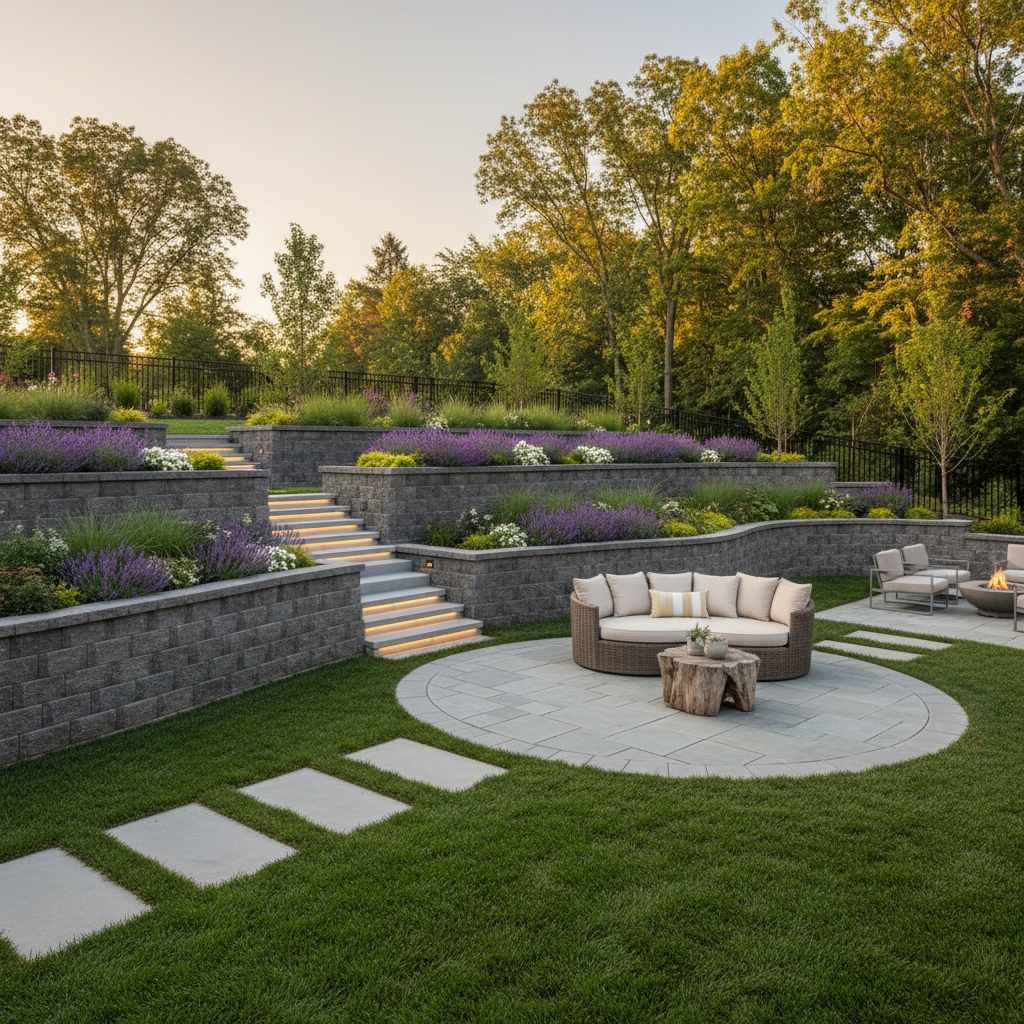
Retaining wall solutions for sloped yards are engineered systems that hold back soil to create level, usable terraces while controlling drainage and erosion. In Mississauga from our base at 100 Matheson Blvd E unit 202, HR Greenroots Landscaping plans and builds block, armor stone, and terraced walls with proper base preparation, geogrid, and drainage so your slope becomes safe, stable living space.
By HR Greenroots Landscaping • Last updated: 2026-06-03
Quick Summary
A good retaining wall turns a slope into flat, usable areas and prevents erosion by pairing strong base prep with drainage and reinforcement. Choose a system based on height, soil, and access: SRW block with geogrid for taller tiers, armor stone for rugged appeal, or terracing for multi-level planting and paths.
This complete guide shows you how to pick, design, and build walls that last in Ontario’s freeze-thaw climate—without overbuilding. You’ll get clear methods, step-by-step workflows, and local tips our team uses daily.
- What a retaining wall is and how it works in plain language
- When to choose block, armor stone, concrete, timber, or gabions
- Drainage, base, and geogrid rules that prevent movement
- Step-by-step build checklists you can follow or audit
- Local considerations for Mississauga and the Regional Municipality of Peel
- Actionable examples from real residential scenarios
- Internal resources: our retaining wall service page, retaining wall drainage guide, and retaining wall design principles.
What is a retaining wall (for sloped yards)?
A retaining wall is a structure that holds back soil on a slope to create level ground and prevent erosion. Proper walls rely on base preparation, drainage stone, and reinforcement (like geogrid) so the soil’s lateral pressure is redirected safely without pushing the wall forward or outward over time.
In practice, a wall is a gravity and friction system that resists lateral earth pressure. The wall’s mass, batter (setback), and connection to reinforced soil behind it form a stable block. Water is managed by free-draining backfill, a perforated pipe, and weep paths to avoid hydrostatic pressure, which is a common cause of failure.
- Wall mass and geometry: Taller walls need more mass or reinforcement. Battered faces increase stability.
- Soil behavior: Wet soils exert more pressure than dry, granular soils. Clay behaves differently than sandy loam.
- Drainage control: Clean angular stone, filter fabric, and outlets keep water moving away from the wall.
- Reinforcement: Geogrid layers tie the wall face to compacted soil, creating a “composite” gravity structure.
We build these elements into our projects so walls stay true through Ontario’s seasonal cycles.
Why retaining walls matter for safety, usability, and drainage
Retaining walls make steep yards usable and safer by carving flat zones for patios, play, or parking. They also manage runoff by draining water through stone, not soil. The result: less erosion, fewer muddy paths, and better property circulation with durable, easy-to-maintain grades.
Without a plan, sloped yards waste outdoor square footage and create risks at stairs, edges, and driveway margins. A well-designed wall adds level space and controls water flow, which protects foundations, walkways, and lawns. We often pair walls with interlocking pavers, sod installation, and clean edge control so circulation feels natural.
- Usability gains: One sloped lawn can become two or three flat terraces for dining, gardening, and storage.
- Surface protection: Directing rain into stone backfill reduces surface washouts and rutting.
- Landscape cohesion: Integrated stairs and landings connect decks, sheds, and garden beds.
- Maintenance simplicity: Stable grades reduce mower scalping and patchy turf, especially after slope correction work.
For many Mississauga homes, a strategic wall unlocks parking with a driveway extension, ties into a new fence line, and frames low-maintenance beds.
How retaining walls work (forces, base, drainage)
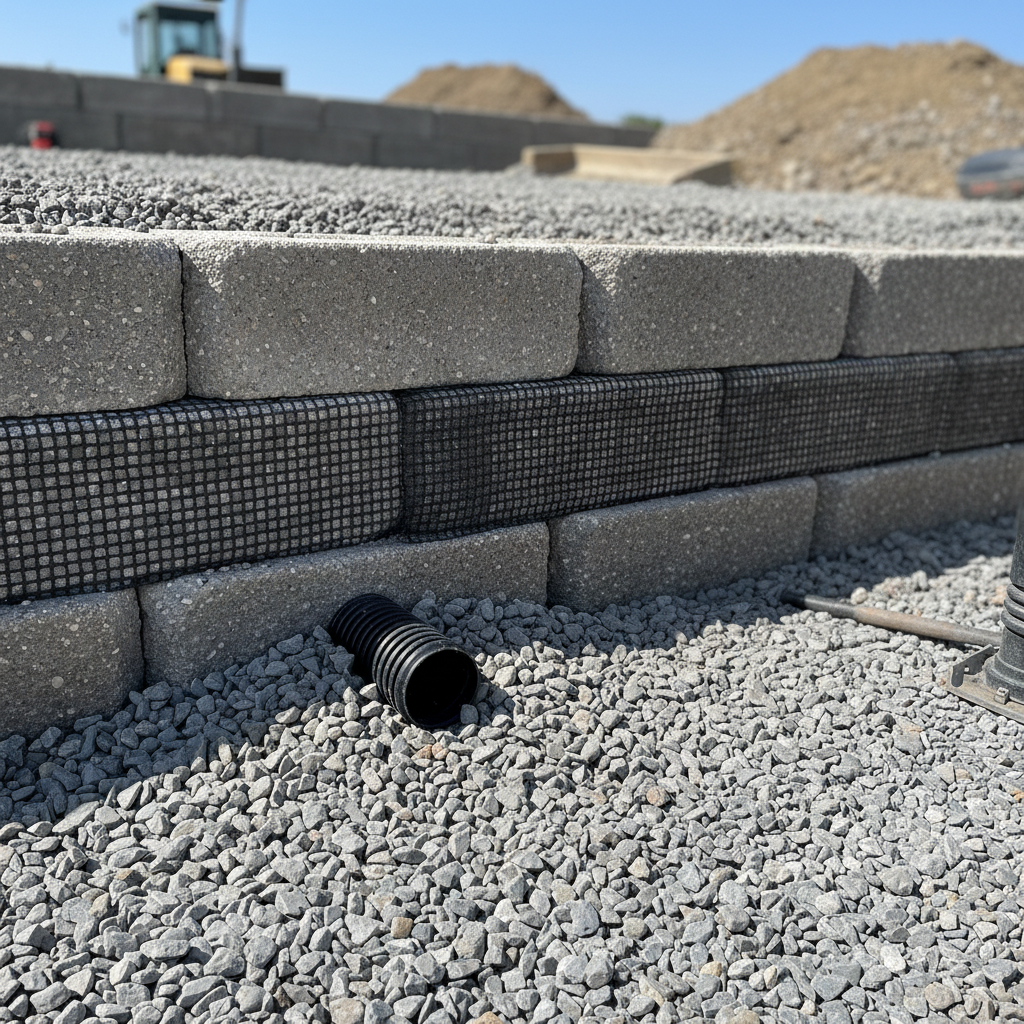
Retaining walls work by resisting lateral soil pressure through mass, friction, and reinforcement. A compacted gravel base spreads load; clean stone and a drain pipe relieve water; geogrid ties the face to reinforced soil. Together, these elements prevent sliding, overturning, and bulging.
Here’s the anatomy we build into most small-to-mid residential projects:
- Compacted base: A dense, level foundation of well-graded aggregate creates uniform support.
- Free-draining backfill: Clean stone behind the wall moves water to a perforated drain line.
- Filter fabric: Geotextile separates soil from stone, keeping the drain zone clean.
- Geogrid reinforcement: Installed in layers for taller walls or poor soils; grid length typically equals 0.6–1.0 times wall height.
- Setback/batter: Each course steps back slightly to improve stability.
- Outlets/weeps: Daylight drains or dry wells prevent water buildup.
When height, soil conditions, or space constraints demand it, we may shift to armor stone gravity walls or terraced SRW segments to distribute loads and enhance aesthetics. That decision hinges on access, desired look, and how the space will be used.
Types and methods: choosing the right retaining wall for your slope
Pick a wall type based on height, soil, access, and aesthetics. SRW block with geogrid suits most residential slopes; armor stone excels for rugged style and tight access; poured concrete delivers monolithic strength; timber and gabions are situational choices where appearance or drainage needs dominate.
Segmental retaining wall (SRW) block with geogrid
- Best for: 3–12 ft of total retained height (often split into terraces) where a premium finish and engineered performance are desired.
- Why it works: Interlocking units, setback, and geogrid create a composite mass. Free-draining stone keeps pressure low.
- Where we use it: Patios, walkways, and pool surrounds tied to our retaining wall builds and cohesive design plans.
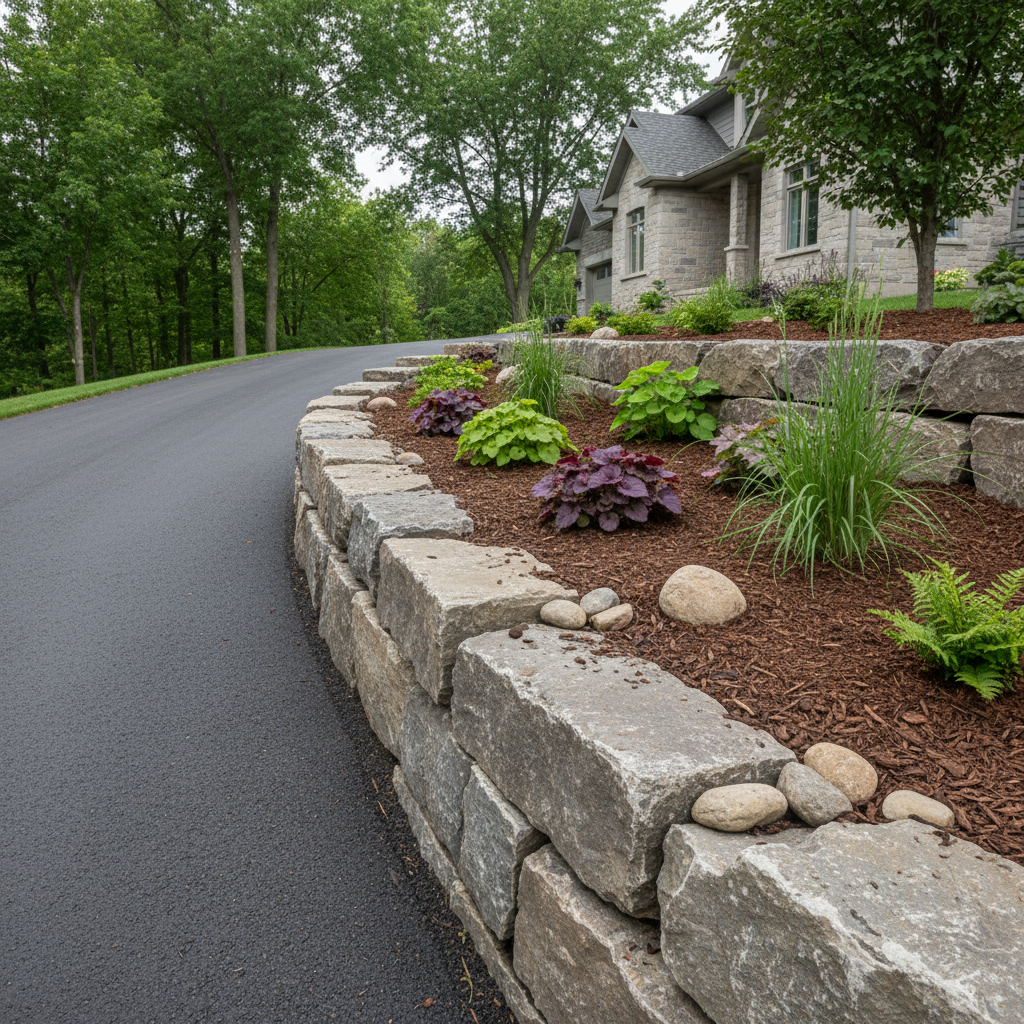
Armor stone gravity walls
- Best for: Natural, sculptural look; good for tight access where smaller blocks are impractical.
- Why it works: Massive stone units rely on weight and friction; looks great with native plantings and mulch.
- Where we use it: Driveway margins, garden terraces, and transitions to woodland edges.
Poured concrete (cast-in-place)
- Best for: Narrow footprints or when a smooth/architectural finish is required.
- Key notes: Requires formwork, steel reinforcement, and careful drainage design at the base and behind the wall.
- Consider: Often paired with veneer stone or steps for a warmer look.
Timber walls
- Best for: Low heights where a rustic, budget-conscious appearance is acceptable.
- Key notes: Susceptible to long-term rot; ensure drainage and separation from soil where possible.
Gabion baskets
- Best for: Highly permeable structures and streambank-like edges.
- Key notes: Excellent drainage; industrial aesthetic; requires careful tie-ins to adjacent grades.
Terracing and integrated stairs
- Best for: Steep backyards that need connected zones: dining, play, shed access.
- Design move: Two 3–4 ft terraces are often friendlier than one tall wall, especially when combined with robust drainage details.
Materials aside, the winning formula is consistent: stable base, reliable drainage, and appropriate reinforcement. That’s what keeps courses aligned and faces crisp years after installation.
Best practices that prevent wall movement in sloped yards
Winning retaining walls start with excavation to undisturbed subgrade, a compacted aggregate base, and clean stone backfill. Add filter fabric, daylighted drain lines, and geogrid at specified intervals. Keep surface water away with grading and edge control. These basics stop bulging, tilting, and frost heave.
- Base depth and width: Excavate to firm subgrade; base width usually extends past the block toe and heel for uniform support.
- Compaction: Compact in thin lifts with a plate compactor to reach a dense, level base and backfill.
- Drainage path: 3/4" clear stone and a perforated pipe wrapped with fabric move water freely to an outlet or dry well.
- Geogrid intervals: For taller walls, place grid every few courses, extending deep into reinforced soil.
- Surface water control: Grade the upper terrace to shed water away; include a shallow swale if needed.
- Freeze-thaw: Use free-draining materials and adequate base thickness to limit frost action.
- Edge control: Finish with interlocking pavers, sod, or mulch to lock grades and reduce erosion.
We document these practices in pre-build checklists and then verify them on-site. It’s the difference between a wall that just looks straight on day one and one that stays straight.
Retaining wall solutions for sloped yards in Mississauga and Peel
In Mississauga and the Regional Municipality of Peel, the best retaining wall solutions balance drainage, freeze-thaw resilience, and neighborhood aesthetics. Tiered SRW block walls with geogrid, armor stone gravity walls, and integrated stairs are proven options that convert steep lots into functional, connected outdoor rooms.
Neighborhood soils and topography vary, but water management and base prep remain constant. We tailor walls to your yard’s use: seating terraces near the deck, widened driveway edges, or shed-leveling pads. See how this ties into our landscape design-build approach that links planting, hardscapes, and maintenance from the start.
Local considerations for Mississauga
- Route surface runoff away from structures and along planted edges; near Saigon Park, properties often benefit from shallow swales feeding stone backfill rather than topsoil alone.
- Plan build windows around spring thaws and late-fall precipitation. Dry, compactable conditions help reach target density in base and backfill.
- For projects close to Lambton College campuses or busier streets, schedule material deliveries to avoid peak traffic and coordinate site access for larger stone or block pallets.
Step-by-step: our retaining wall workflow (you can audit this)
A reliable wall follows a reproducible sequence: survey and layout, excavation, base compaction, first-course leveling, drainage placement, geogrid installation, backfill compaction, cap installation, and surface finishing. Auditing each step prevents compounding errors and keeps courses aligned.
- Site walk and scope: Confirm use zones (seating, play, parking) and tie-ins to decks, paths, and sheds.
- Layout and elevations: Mark top and bottom of wall, steps, and drainage outlets with reference stakes.
- Excavation: Cut to undisturbed subgrade with room for base, drain stone, and setback.
- Base preparation: Install well-graded aggregate; compact in thin lifts to create a level, dense platform.
- First course set: Level front to back and side to side; this governs every course above.
- Drainage layer and pipe: Place clean stone and perforated pipe to daylight or basin.
- Stack and setback: Build courses with staggered joints; check alignment and batter.
- Geogrid installation: Where specified, place grid between courses and tension into compacted backfill.
- Backfill and compact: Alternate a course with backfilling and compacting to avoid slumping.
- Finish grade and caps: Glue caps as required; shape upper and lower grades for water shed.
- Surface finishes: Add interlocking pavers, mulch, or sod for edge control and movement.
- Punch list and photos: Verify drainage outlets, cap alignment, and transitions; document completion.
Use this sequence to evaluate any contractor’s plan. If steps are missing, ask how water will be managed and what controls keep the wall true after freeze-thaw cycles.
Comparison guide: match solutions to slope, height, and access
Match the wall to your site: SRW block with geogrid for most residential heights, armor stone for rugged style and tight access, poured concrete for narrow footprints, and terracing when a single tall wall isn’t practical. The right choice depends on soil, height, drainage, and aesthetics.
Wall type Best for Typical max height Footprint depth Drainage/frost notes Upkeep SRW block + geogrid Most yards; premium finish 8–12 ft (terraced) Moderate Free-draining stone + pipe Low; inspect outlets Armor stone gravity Rugged look; tight access 4–6+ ft (site-dependent) Large stones need room Excellent mass; drain path helps Very low Poured concrete Narrow footprints Varies (engineered) Minimal Critical base and drainage Low; inspect cracks Timber Low walls; rustic 3–4 ft Moderate Good drainage essential Medium; monitor decay Gabions Permeable structures Varies (engineered) Moderate Highly permeable Low; occasional wire checksIf you’re unsure, we can map a terraced SRW concept alongside armor stone so you can weigh look, access, and future maintenance.
Tools and resources for planning your wall
Plan with a site sketch, elevation references, and a checklist for base, drainage, and reinforcement. The essential tools include a plate compactor, level/laser, saw for block or stone, tamper, and geotextiles. Pair this with internal guides on drainage, design, and slope correction.
- Tools: Plate compactor, laser level, masonry saw, hand tamper, shovel, wheelbarrow, PPE.
- Materials: Well-graded base aggregate, clean 3/4" stone, SRW units or armor stone, geogrid, filter fabric, perforated pipe.
- Planning resources: Our retaining wall drainage explainer, slope correction guide, and design-build overview.
Use a simple elevation sketch to confirm how many steps you’ll need between terraces. The drawing doesn’t have to be fancy—it just needs consistent reference heights to keep everything tied together.
Soft CTA: Want a second set of eyes on your layout? Book an on-site assessment with our team so we can right-size the wall height, confirm drainage paths, and align the finish with your outdoor goals.
Case studies and real-world examples
The best designs solve a site’s specific problems. These Mississauga-area examples show how retaining walls add parking, connect decks and patios, and turn steep back lawns into multi-use terraces—while keeping water off paths and foundations.
Backyard terraces + interlock landing
- Problem: Steep lawn with muddy desire lines from deck to shed.
- Solution: Two SRW terraces with integrated stairs and a small interlocking landing.
- Result: Clean circulation, less tracking of soil into the house, and a sunny planting bed.
Driveway edge retention + widened parking
- Problem: Side slope caving into driveway; limited parking.
- Solution: Armor stone gravity wall with mulch and native grasses; driveway extension aligned to the stone face.
- Result: Stable edge control and one additional parking stall with improved curb appeal.
Pool zone privacy + grade control
- Problem: Pool deck cut into slope with exposed soil edges.
- Solution: Terraced SRW walls with ornamental grasses and a privacy fence above the upper terrace.
- Result: Softer edges, better privacy, and easy mowing on flat turf shelves.
These layouts often pair well with our retaining wall service plus interlocking for steps and landings and sod installation to stabilize new terraces.
Frequently Asked Questions
Homeowners ask about height limits, drainage, and when to reinforce. The short answers: follow a repeatable build sequence, use drainage stone with a perforated pipe, and add geogrid for taller walls or poor soils. When in doubt, terrace the slope and connect levels with steps.
What is the most reliable retaining wall for a steep backyard?
For most homes, a segmental retaining wall (SRW) with geogrid is the most versatile and reliable choice. It pairs interlocking block with reinforced backfill and clean stone drainage. For rugged style or tight access, armor stone gravity walls perform well when built on a compacted base.
Do I always need geogrid in a retaining wall?
No. Short walls on firm soils may not need reinforcement. As retained height increases, geogrid layers bond the wall face to compacted soil, creating a stronger composite mass. We add grid at specified intervals for taller segments or weaker soils to prevent bulging and movement.
How do I handle water behind a wall?
Use clean 3/4" stone as backfill, install a perforated drain pipe at the base, wrap with filter fabric, and daylight the line or route to a dry well. Grade surfaces above to shed water away. This reduces hydrostatic pressure, a common cause of wall failure.
Is terracing better than one tall wall?
Often, yes. Two mid-height terraces usually integrate better with stairs, planting beds, and paths than a single tall wall. Terracing spreads loads, improves access, and creates more usable square footage on steep sites.
Conclusion and key takeaways
Retaining wall solutions for sloped yards work when base, drainage, and reinforcement are treated as non-negotiables. Choose the wall type to match your height, soil, and access, and terrace when possible. The payoff is stable, low-maintenance outdoor space you’ll actually use.
- Pick the system to match height, soil, access, and look.
- Control water with clean stone, fabric, and a perforated pipe to daylight.
- Reinforce wisely with geogrid at specified intervals for taller segments.
- Terrace steep sites for safer, more connected outdoor rooms.
- Audit the build using the step-by-step workflow above.
Ready to turn your slope into usable space? Explore our retaining wall services and review drainage details in our drainage guide. We’ll align structure, planting, and maintenance so it lasts.


